


In conflict-affected environments, the populations most at risk are often not the combatants themselves, but civilians—particularly women and children.
– Dr. Marcus King
When Water Becomes the Target of War
Water Security & Public Health in the Iran War and Beyond
This Q&A features the complementary expertise of Professors Marcus King, director of the MS in Environment & International Affairs, and Jessica Kritz, Academic Co-director of the MS in Climate, Environment & Health.
King, a specialist in water security and conflict, focuses on how environmental stressors—particularly water scarcity—shape geopolitical instability and risk. Kritz, whose work centers on environmental health and governance, examines how water systems, infrastructure, and community dynamics influence both physical and mental well-being.
What is “water security,” and how does it connect to health and international affairs?
Marcus King: Water security is the capacity of a population—or, more often, a nation-state—to ensure sustainable access to sufficient quantities of acceptable-quality water for three core purposes: sustaining livelihoods, human well-being, and socio-economic development; protecting against water-borne pollution and water-related disasters; and preserving ecosystems to support peace and political stability.
Who is most at risk at the intersection of conflict, water scarcity, and health?
Marcus King: In conflict-affected environments, the populations most at risk are often not the combatants themselves, but civilians—particularly women and children. When water becomes scarce, women and girls are frequently responsible for securing household water supplies, often requiring travel over long and unsafe distances. In these contexts, they face heightened exposure to the dangers of conflict, including sexual and gender-based violence.
Children, especially infants, are likewise highly vulnerable. Many are forced to live in temporary camps or informal settlements where water, sanitation, and hygiene (WASH) conditions are severely degraded. As a result, they face elevated risks of diarrheal diseases and other waterborne illnesses, which remain a leading cause of mortality in such settings.
Forced migrants—including refugees and internally displaced persons (IDPs)—constitute another highly vulnerable and often overlapping group. Conflict frequently severs their access to livelihoods and to reliable water sources. The areas to which they flee are often unplanned or under-resourced, lacking adequate groundwater availability, water infrastructure, or distribution systems. In many cases, existing systems have been damaged or destroyed by the very conflicts these populations are escaping.
These dynamics also generate significant environmental pressures in host and transit areas. Sudden population influxes can exceed the ecological carrying capacity of local systems.
Professor Kritz, much of your work has focused on clean water access. Can you tell us about the human health aspects of access to water, and any human health consequences beyond lack of access to drinking water that deserve attention?
The human right to water is the right of an individual, but sustainable water delivery happens through systems.
Dr. Jessica Kritz
Jessica Kritz: The human right to water is the right of an individual, but sustainable water delivery happens through systems. When water systems are inconsistent or unsafe, the risks extend beyond waterborne disease. They include chronic exposure to waste, flooding, and degraded environmental conditions that affect respiratory health, nutrition, and long-term well-being. These challenges are compounded in rapidly urbanizing areas where infrastructure, environmental change, and population pressures intersect.
Water, technology, and psychological warfare
Professor King, you’ve been quoted as saying that Iran, though limited in its offensive capability, can have an outsized impact by attacking Gulf Countries desalination plants, because this has a psychological effect on the population. Can you tell us more about this psychological impact?
Marcus King: Attacks on desalination plants in Gulf countries have an outsized psychological impact because water is an immediate and non-substitutable necessity. Unlike disruptions to oil or electricity, which primarily affect markets and economic activity, interruptions to water supply threaten daily survival within a matter of days.
In many Gulf states, desalination provides the overwhelming majority of potable water, leaving populations acutely aware that even short-term disruptions could quickly escalate into a crisis affecting households, hospitals, and basic sanitation. This immediacy generates a level of fear and urgency that far exceeds most other forms of infrastructure attack.
Unlike disruptions to oil or electricity, which primarily affect markets and economic activity, interruptions to water supply threaten daily survival within a matter of days.
Dr. Marcus King
This vulnerability is compounded by the highly centralized nature of desalination systems. A relatively small number of large, fixed facilities supply water to entire urban populations, creating clear single points of failure. Even a limited or symbolic strike can signal systemic fragility, undermining public confidence in the resilience of essential infrastructure. Because the effects of disruption—such as reduced water pressure, rationing, and service interruptions—are rapidly visible and universally experienced, they can trigger collective anxiety, panic behaviors such as hoarding, and a broader loss of trust in government capacity.
The psychological impact is further amplified by the political and social context of Gulf states, where state legitimacy is closely tied to the reliable provision of high living standards and essential services. Desalination is what makes large-scale urban life possible in an otherwise arid environment. As such, any perceived inability to guarantee water security challenges the implicit social contract between state and society. This is particularly acute in highly urbanized settings, where dense populations and extreme climatic conditions leave few alternatives if water systems fail.
Taken together, targeting desalination infrastructure is strategically potent not only because of its immediate physical destruction, but because it transforms infrastructure vulnerability into civilian fear and political pressure. It exploits dependence, centralization, and the existential importance of water, creating a perception of systemic fragility that can destabilize societies far beyond the scale of the initial attack.
Facing compounding challenges, especially in times of conflict
Professor Kritz, how should international actors prioritize interventions when facing simultaneous infrastructure, environmental, and public health crises?
One of the central arguments in my work on Redefining Development is that prioritization cannot be done effectively through top-down, sector-by-sector approaches. Infrastructure, environmental conditions, and public health are deeply interconnected, and addressing them in isolation leads to fragmented and unsustainable results. The evidence is very clear that these kinds of interventions are designed to fail.
Instead, what we’ve seen in Ghana and through the GOGREEN project is that the most effective approach is to invest in collaborative governance processes. This means bringing together government actors, non-governmental organizations, community stakeholders, and scientists into structured platforms where priorities can be jointly defined and coordinated.
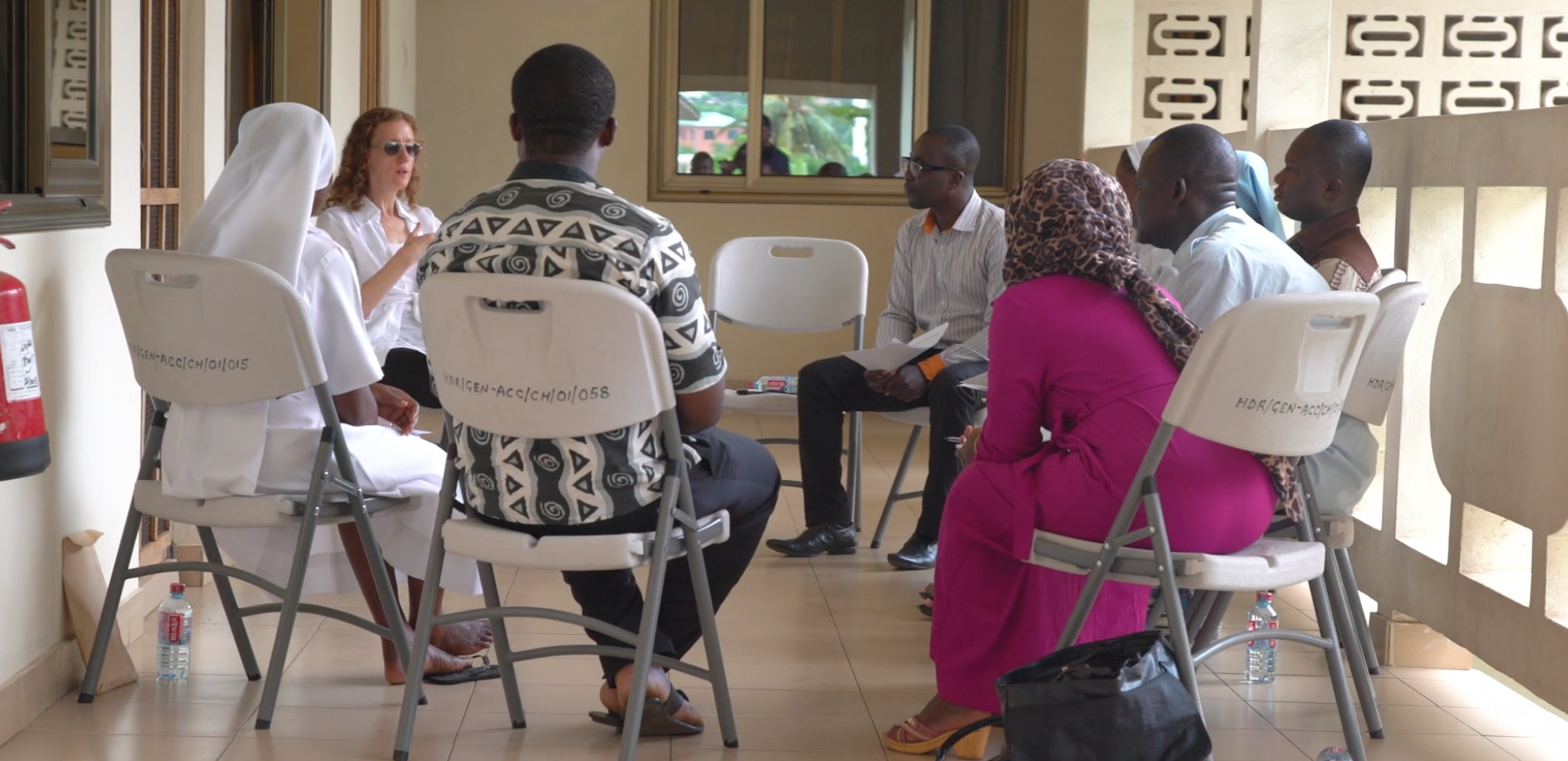
Rather than asking which intervention comes first, the more effective strategy is to ask how to build systems that enable coordinated, accountable, and inclusive action.
– Dr. Jessica Kritz
In these settings, communities contribute lived experience and local knowledge, NGOs and practitioners bring implementation capacity, scientists contribute evidence and analysis, and government provides the authority and systems needed for scale and sustainability. When these roles are aligned, prioritization becomes a shared, iterative process rather than a fixed external decision.
This approach is also central to my emerging work in Administration and Human Rights (AHR). Human rights frameworks help clarify obligations and minimum standards, I argue that collaborative governance provides the mechanism to operationalize those commitments across sectors.
So rather than asking which intervention comes first, the more effective strategy is to ask how to build systems that enable coordinated, accountable, and inclusive action. That is what ultimately leads to more durable and equitable outcomes.
Professor King, how might typical public health and water infrastructure interventions differ in areas facing conflict and war? What are the promising strategies to build resilience in both health systems and water systems during conflict?
Public health and water infrastructure interventions differ significantly between conflict settings and stable environments in terms of time horizon, delivery model, and institutional context. In stable settings, interventions are typically long-term, systems-oriented, and implemented through formal state institutions. In contrast, conflict settings require short-term, adaptive, and survival-focused approaches, often in the absence of effective governance.
First, the objective shifts from optimization to survival. In stable contexts, interventions emphasize efficiency, sustainability, and regulatory compliance—such as expanding water networks, improving wastewater treatment, and strengthening health systems. In conflict settings, the priority is immediate risk reduction: ensuring access to safe drinking water, preventing disease outbreaks, and maintaining basic sanitation through emergency measures like water trucking, point-of-use treatment, temporary latrines, and rapid vaccination campaigns.
Second, delivery mechanisms differ. In stable environments, governments and utilities are the primary providers. In conflict zones, degraded or destroyed systems shift responsibility to humanitarian actors, NGOs, and international organizations. Interventions must operate under insecurity, limited access, and disrupted supply chains, favoring modular, mobile, and redundant solutions over centralized infrastructure.
Third, risk and operational conditions are far more uncertain. Planners must account for population displacement, sudden demand surges, and infrastructure damage, while public health systems operate with limited data and weak surveillance.
Finally, the relationship between infrastructure, environment, and conflict dynamics is more tightly coupled. In war settings, water systems are not just service delivery mechanisms but can become strategic assets or targets. Overuse of local water sources, breakdown of sanitation systems, and environmental degradation (e.g., deforestation, aquifer depletion) can further destabilize already fragile contexts. This creates a feedback loop in which degraded water and health conditions exacerbate humanitarian crises, which in turn place additional strain on limited resources.
In sum, while stable environments prioritize efficiency, resilience, and long-term development, conflict settings demand flexibility, rapid deployment, and life-saving impact under conditions of extreme uncertainty and insecurity.
In the news
Recent coverage highlights growing concern around water infrastructure as a target in conflict from Earth Commons Faculty:
- WBUR’s Here & Now featured Marcus King on the risks of desalination attacks in the Middle East
- Marketplace featured Dr. King’s insights when reporting on how threats to water systems could shape future conflicts
- ECo Faculty Raha Hakimdavar warns that attacks on desalination infrastructure pose a major risk to water security in one of the world’s most water-scarce regions. Read in Al Jazeera
Explore Environmental Degrees

MS in Climate, Environment & Health
Apply Now
MS in Environment & International Affairs
Explore the degree
MS in Environment & Sustainability Management
Apply Now